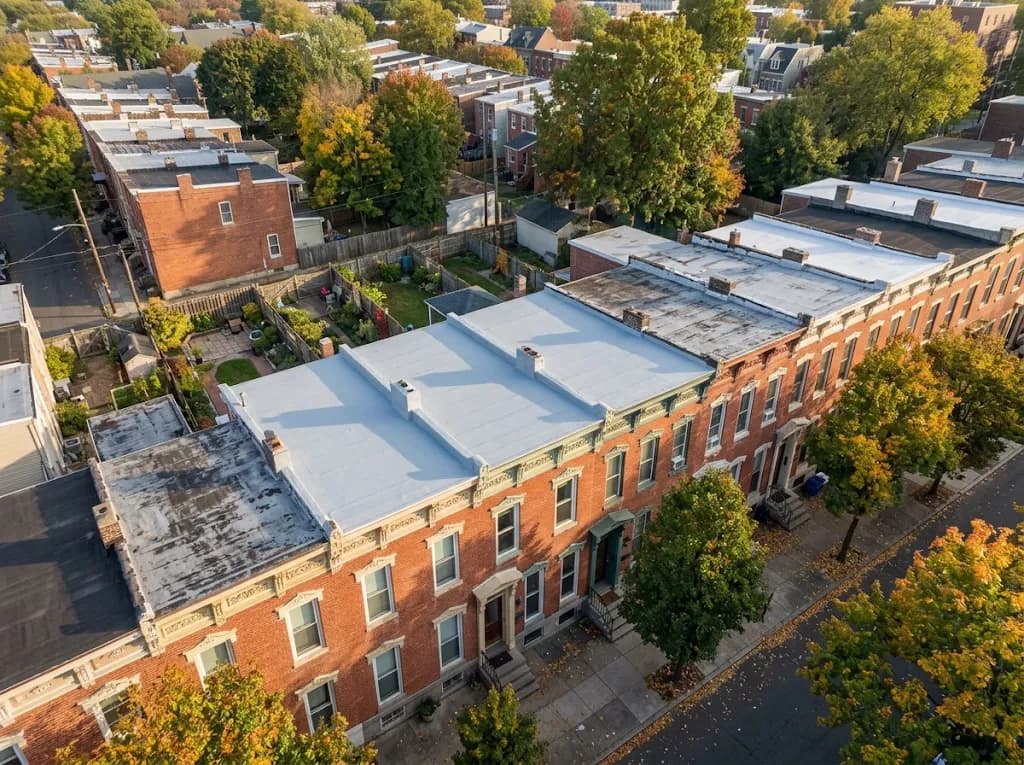
"Trenton Makes, the World Takes." The slogan came from a 1910 Chamber of Commerce contest, and it still glows on the Lower Trenton Bridge over the Delaware. It describes the city that built most of the houses standing today: a manufacturing center where pottery and wire factories boomed in the 1800s, and where John A. Roebling moved his wire rope business in 1848.
A city of rowhouses
The Mill Hill Historic District is the clearest example. Its National Register nomination counts 284 buildings, 263 of them rowhouses, predominantly brick and built mostly in the middle to late 19th century. The most common type, more than a third of the district, is a three-story, three-bay brick rowhouse. Decoration ranges from late Greek Revival through Italianate, Second Empire and Eastlake, depending on when each was built.
Many of these houses fell into disrepair in the 20th century and were later restored, often converted back to single-family homes. Similar attached houses run through much of the rest of the city.
What that means for your roof
| Feature | What to plan for |
|---|---|
| Low-slope roof | Membrane roofing, not shingles; see rowhouse and flat roofs |
| Party walls on both sides | Flashing that ties into the neighbors' roofs |
| Front cornice | Covering and flashing the top so it does not hold water |
| Attached house | A construction permit may be needed; ask the city |
| Narrow street | Dumpster placement and debris removal need planning |
Not every Trenton house is a rowhouse. Twins, two-family houses and detached single-family homes fill many neighborhoods, especially toward the city's edges. Detached houses with shingle roofs follow the asphalt shingle approach.
Before you sign
Check the contractor's New Jersey registration (the number starts with 13VH), read the contract, and confirm who is filing any permit. The registration guide walks through it.
Need a new roof in Trenton? Call a roofer who works there.
Mon–Fri 8:30 am – 7 pm, Sat 9 am – 4 pm ET
Questions & answers
Do Trenton rowhouses need a permit for a new roof?
New Jersey's permit exemption for re-roofing covers detached one- and two-family houses. Rowhouses are attached, so check with Trenton's construction office before work starts. A registered contractor can usually file the application.
My house is in the Mill Hill Historic District. Does that change anything?
The front of a Mill Hill rowhouse is what the district protects, and most of these roofs are low-slope and barely visible from the street. Still, ask the city whether historic approval applies before changing anything visible, such as the cornice or roof edge.
Can one roofer do my roof and my neighbor's?
Yes, and on attached houses it is often the better approach. The joint between the two roofs gets flashed once, properly.