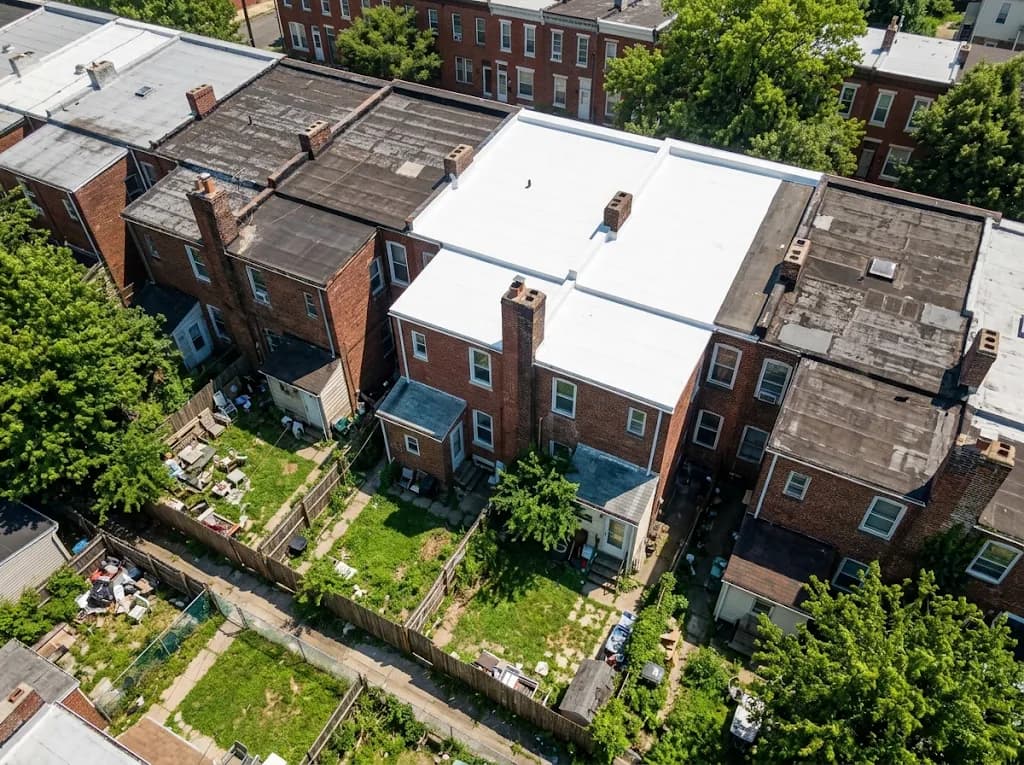
Trenton is a rowhouse city. In the Mill Hill Historic District alone, the National Register nomination counts 284 buildings, 263 of them rowhouses, mostly brick and mostly built between the middle and the end of the 19th century. The same pattern runs through much of the city: attached houses, two or three stories tall, with low-slope roofs hidden behind a front cornice.
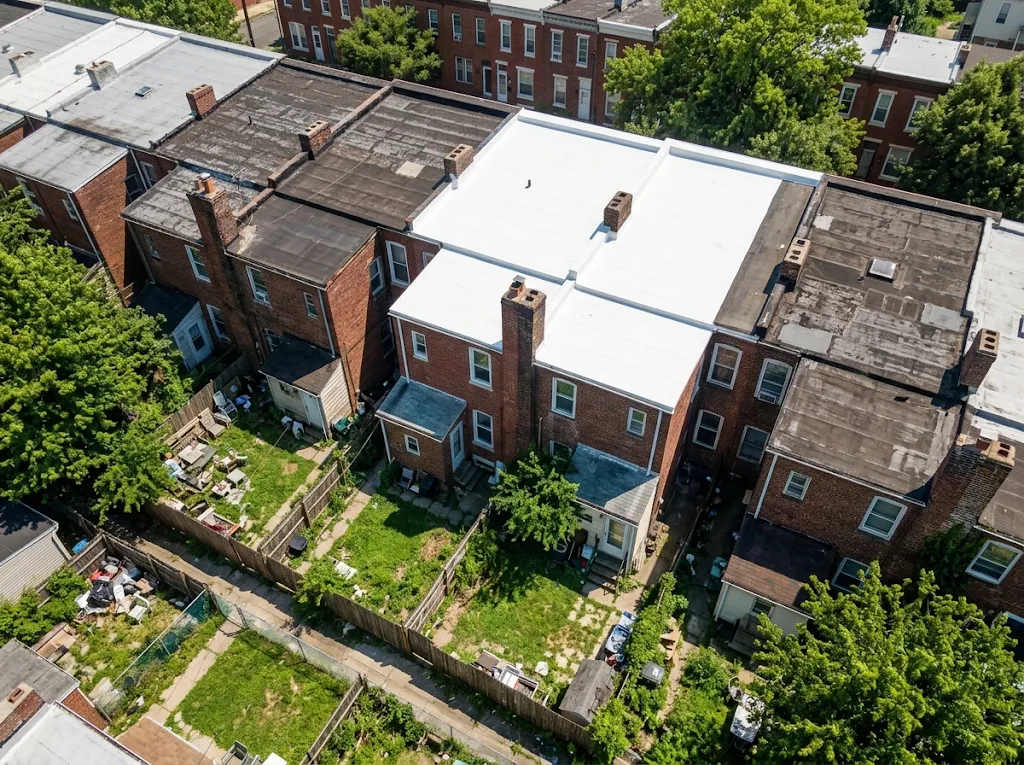
Why rowhouse roofs are their own category
- They are nearly flat. The slope runs gently from front to back, too shallow for shingles, so they are covered with membrane roofing.
- They share edges. Your roof meets your neighbors' roofs along both party walls. Water does not respect property lines.
- They have parapets and cornices. The front cornice and any parapets need their own flashing and coping.
- They are attached. That affects permits in New Jersey, as explained below.
Membrane options
| Membrane | What it is | Worth knowing |
|---|---|---|
| EPDM | Synthetic rubber sheet, usually black | Long track record on Northeast rowhouses |
| TPO | White sheet with heat-welded seams | Reflects summer heat off the top floor |
| Modified bitumen | Asphalt-based rolls, torched or self-adhered | Tough under foot traffic |
The membrane matters less than the drainage. Ask how water will leave the roof: toward a rear gutter, a scupper or an interior drain, and whether low spots will be built up with tapered insulation.
The party-wall joint
Where your roof meets the house next door, there may be a low brick parapet, a metal cap, or simply two roofs butting together. Each needs a different detail. If the neighbor's roof is also old, replacing both at once gives the cleanest result, and some roofers will take on two adjoining roofs as one job.
Attached houses and permits. Since 2018, re-roofing a detached one- or two-family house in New Jersey is generally treated as ordinary maintenance that needs no construction permit. Rowhouses and other attached homes are not covered by that exemption, so check with your municipal construction office. See New Jersey roof permits.
What a full replacement includes
- Tearing off the old roofing, including coats of old patching material, down to the deck
- Replacing rotted decking and building up low spots
- New membrane, turned up the parapets and party walls
- New flashing at chimneys, vent pipes and roof hatches
- New coping on parapets and attention to the top of the front cornice
- A clean drain path: gutter, scupper or drain
Talk with a roofer about replacing this roof.
Mon–Fri 8:30 am – 7 pm, Sat 9 am – 4 pm ET
Questions & answers
Do I need a permit to replace my rowhouse roof?
Possibly. New Jersey's 2018 change that lets detached one- and two-family homes be re-roofed without a construction permit does not apply to attached houses. Ask your municipal construction office before work begins; a registered contractor can usually handle the application.
My neighbor's roof leaks into my wall. Whose problem is it?
Water crossing a party wall is a common rowhouse problem. Where roofs meet at the property line, the flashing has to tie the two together. Replacing both roofs at the same time, or at least flashing the joint properly when one is replaced, solves it most reliably.
How long does a rowhouse roof replacement take?
The roof area is usually small, so the work itself is often a day or two. Access, debris removal on narrow streets and coordination with neighbors can take longer to arrange than the roofing.